Two in three would rather have a second-hand gift that suits them than a new one they won’t use, Vinted research reveals

New Vinted and YouGov research across six countries shows what gets relisted after the holidays, what people would actually love instead, and why "I found this gift on Vinted" is becoming something to say with pride.
Vilnius, November 2026: Every festive season it happens. Short on inspiration, we reach for the gift that seems "always a good idea". Every January, Vinted sees a lot of it come back. New research by Vinted and YouGov¹ across the UK, US, France, Germany, the Netherlands and Poland shows what we'd all rather be unwrapping.
One in two people (56%) receives at least one unwanted gift (1.7 on average) each festive season. Over half (57%) admit they play it safe when buying presents, and one in three (30%) have regretted giving a generic gift instead of something more personal. Vinted sees where those gifts end up: in the week after last Christmas, relisted gifts nearly quadrupled, up 283% on the week before.³
The good news: 67% would rather have a second-hand gift that suits them than a new one they won't use. Their perfect gift probably already exists. So Vinted is calling time on the gift that doesn't land with Vinted’s Gifting Matrix: what gets passed on every January, what people would love instead, and what it costs second-hand.
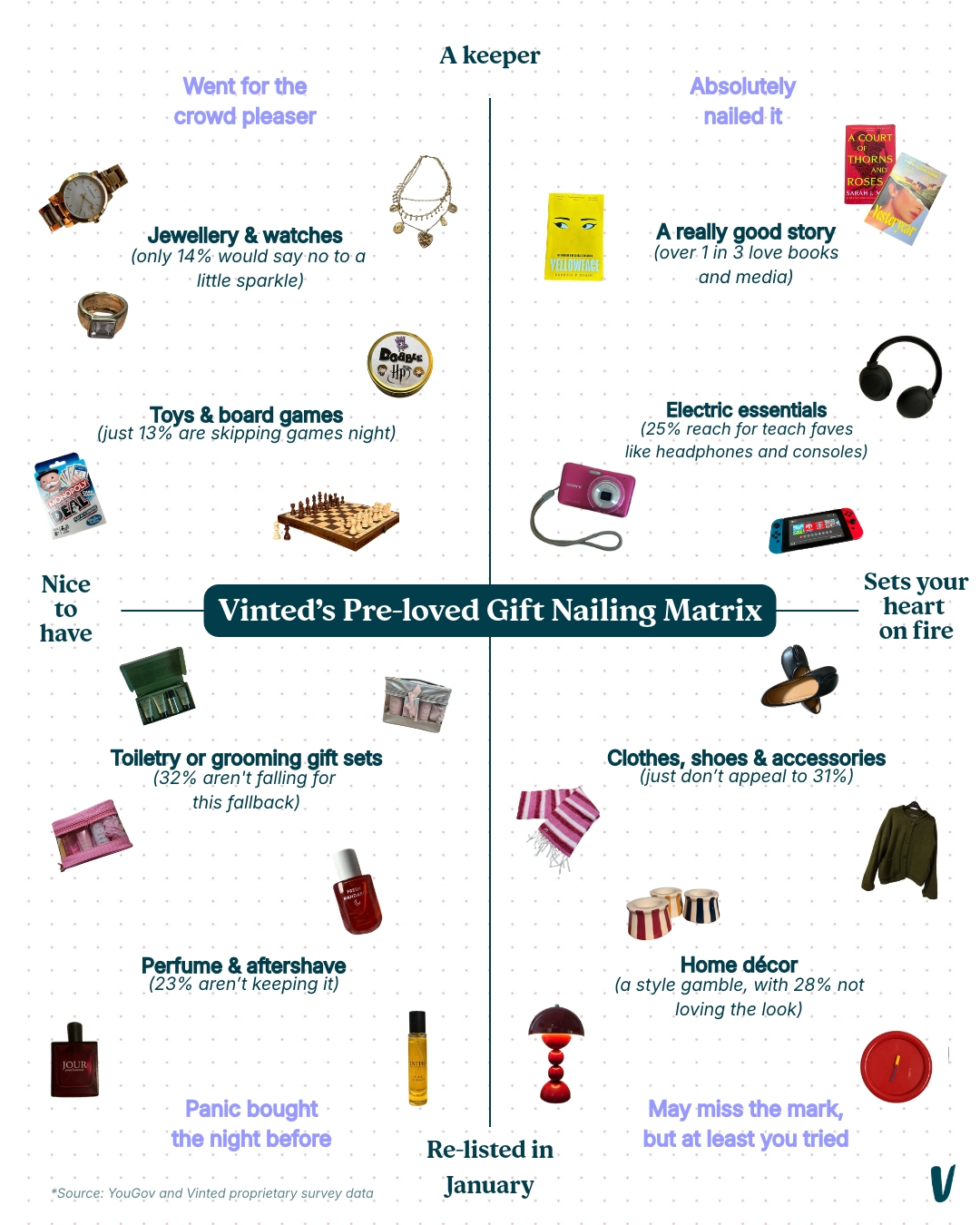
The gifts that get passed on
Asked which presents they've received and not wanted, respondents named toiletry and grooming sets first (32%) [UK 46%], then clothing and accessories (31%), mugs and kitchenware (28%), candles and home décor (27%), socks and slippers (24%) and perfume or aftershave (23%).² Vinted sees the same list from the other side: beauty makes up one in six (16%) of relisted gifts on the platform, ahead of toys and games (11%) and women's clothing (10%).³
People play it safe because they're not sure what the person would like (32%), worried about choosing wrong (27%), or recipients said they didn't want anything (24%).² Some of the hardest people to buy for are the ones closest to us: a parent (17%), a partner (16%), a sibling or a close friend (12% each).²
And the gift that misses? Most people try to pass it on: 40% donate or give it to someone else or a charity, 28% re-gift it, 15% sell it and 10% think about selling but never do. Many still keep it, a third unused (34%) and a third in case (35%).² Millennials sell (21%), Boomers donate (44%), Gen Z keep it in a drawer (40%). The items listed on Vinted don't wait long: in the most relisted categories, an unwanted gift finds a new owner within a day, twice as fast as the typical listing.³
The gift they'd love (and what it costs)
So what leads the wish lists? Clothes in their style (35%), a good book, album or film (35%), electronics like headphones (25%), something for their hobby (24%) or their home (23%).² Vinted is already seeing the search: this autumn, Lego was a top-10 search in the UK, searches for the latest games console were up more than 170% year on year in the UK, France and Germany, and sales of tree decorations rose more than 300% month on month in the same markets.³
Some of the most wanted gifts come with nostalgia. Ask people what would make them happiest to receive second-hand and they go back in time: one in five (20%) name the present they wanted as a child and never got, nearly a quarter (24%) something they once owned and lost.² Of those, 85% and 90% would be happy to unwrap it today. The answers read like a childhood bedroom: "Original Game Boy", "A Lego pirate ship", "Doll house", "Replacing a book I had lent but never got back".
Most of it is on Vinted, and it doesn't cost much. In 2025, Vinted helped members save €21.6 billion compared with original retail prices on adult fashion, showing how second-hand can help shoppers make their money go further. On average, a Game Boy lists for around €20, a Tamagotchi for €13, a Polly Pocket for €9, trading cards from €5, an iPod for about €28.³ On average, Vinted buyers paid 45% less on toys compared with the typical retail prices.⁴
That matters because money is tight. More than a quarter (27%) feel pressure to spend more on gifts than they can afford [US 34%, France 33%, UK 30%], rising to 38% of parents, and 26% plan to spend less than last year. Second-hand takes the pressure off the gift and the wallet.
Closing the second-hand gift gap: happy to receive, starting to give
Second-hand gifting is more welcome than people think: nearly half (45%) are comfortable receiving a second-hand gift, but only a third (32%) are comfortable giving one, yet.
The nerves are misplaced. Second-hand isn't the compromise; playing it safe might be. 59% would be more impressed by someone who put real effort into finding the right gift, especially if it's second-hand, and 36% would happily say the gift they gave was second-hand [France 47%]. Gen Z are already there: most are comfortable receiving second-hand [UK 70%, France 62%] and many Gen Z plan to buy a second-hand gift this year [France 48%, UK 41%, US 40%].
Jessie de la Merced, VP of Corporate Affairs, comments: "Vinted's Gifting Matrix is our cheat sheet for the festive season: it shows what gets relisted every January and what people would love instead. If you're buying gifts, here's the encouraging bit: nearly half of us would happily receive something second-hand, and more than half would be impressed by the effort it took to find it. So this year, you can feel good buying second-hand."
Notes for editors
¹ All survey figures, unless otherwise stated, are from YouGov Plc. Total sample size was 10,860 adults across six countries: UK 2,203, US 2,447, France 2,026, Germany 2,138, Netherlands 1,017, Poland 1,029. Fieldwork was undertaken between 5 and 14 October 2026. The survey was carried out online. The figures have been weighted and are representative of adults aged 18+ in each country. Six-country figures are taken from the combined dataset. Questions on gifts people did not want were asked of those who receive festive gifts; questions on what happens to those gifts were asked of those who receive gifts they do not want.
² Respondents could select more than one answer, so figures do not add up to 100%.
³ Vinted data: an unwanted-gift listing is an item the seller describes as an unwanted present, duplicate gift or regifted item, identified by keyword matching in English, French, German, Dutch and Polish. The post-Christmas increase compares unwanted-gift listings published from 25 to 31 December 2025 with those published from 18 to 24 December 2025. Relisting data covers the UK, France, Germany, the Netherlands and Poland; the US is not included. Prices are median listing prices converted to euros at the rate on the day of listing. Search and sales trends cover 7 to 20 September 2026 compared with the same period in 2025.
⁴ Savings are calculated as the estimated retail price of a similar new item (matching brand, category and market) minus the total amount paid on Vinted. Retail prices benchmarks were collected in October 2026 using a third-party service querying Google Shopping for a representative sample of new items. The final savings are a weighted average based on the items sold between January and September 2026.